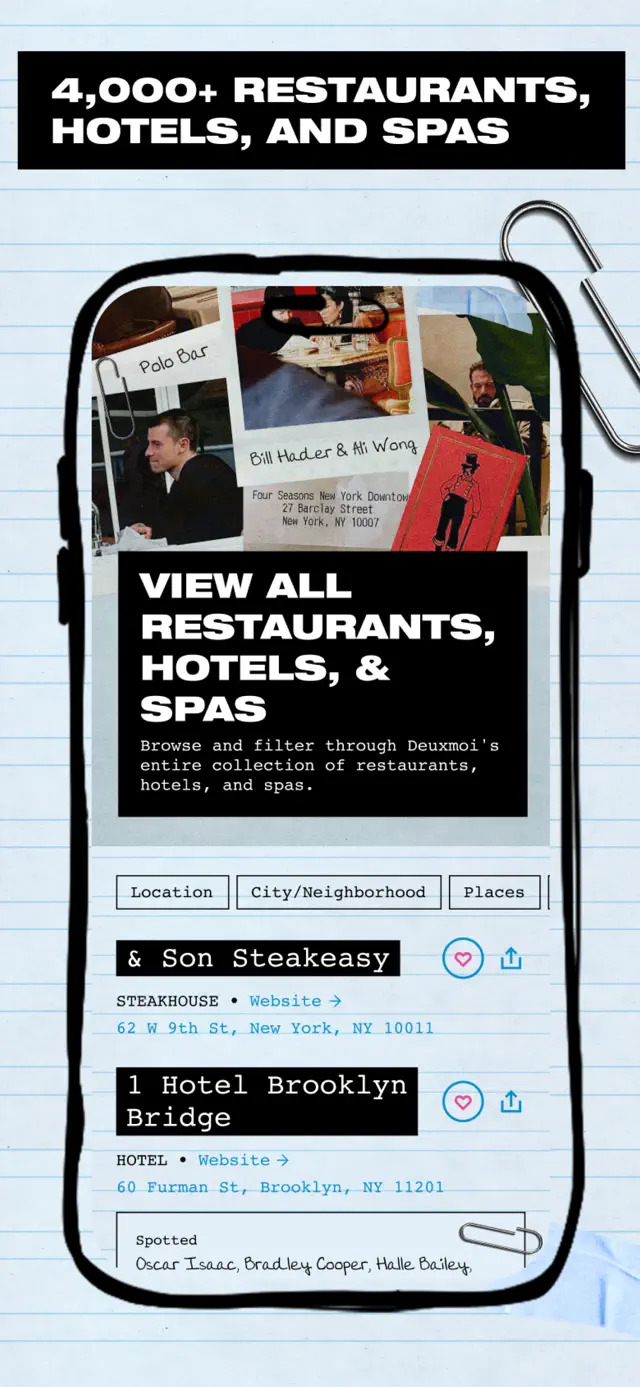
Deuxmoi World is the app version of Deux's little black book: thousands of restaurants, hotels and spas, indexed by which celebrities have actually been spotted there, with the curator's own notes on what to order. You can browse by city, by neighbourhood, by venue type — or by name, if you want to eat where a specific person eats.
Client work. Clutch Developer does mobile engineering on this app as part of the team at L+R in New York. The app belongs to Deuxmoi Media.
What the app does
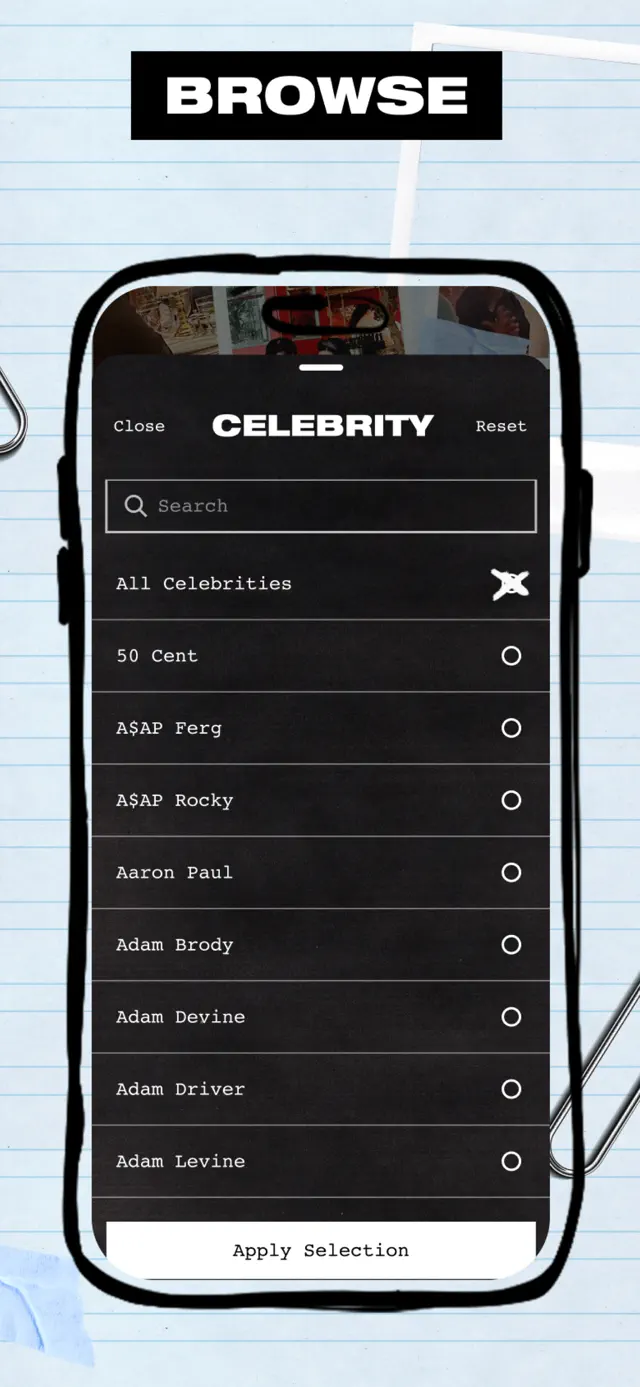
- Filter by celebrity — pick a name, get the places they have been seen.
- Search across venue, city, neighbourhood and cuisine.
- Near Me, because the whole thing is useless if you are in a city and cannot ask what is around you.
- Curator notes — the specific dish, the specific table, the reason it is in the book at all.
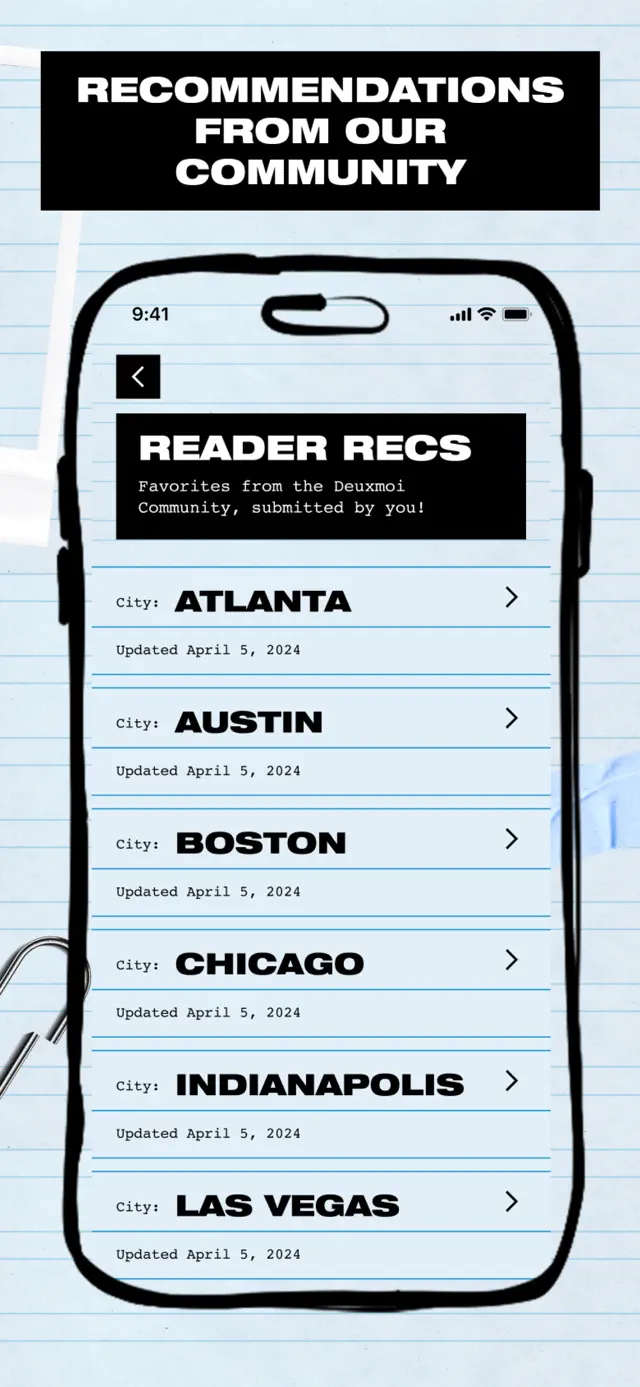
- Community recommendations, organised by city.

The hard part
This looks like a directory app, and directory apps are a solved problem. The difficulty is that the value here is entirely editorial. Someone decided this place belongs in the book and wrote why. The moment the app treats those entries as generic rows in a table, the product becomes a worse Google Maps.
So the filtering has to serve the voice rather than flatten it. A celebrity filter is not a tag — it is a claim about a sighting, with a date and a place, and a venue can carry many of them. City, neighbourhood, cuisine and venue type all cut across each other, and users combine them in ways you cannot enumerate in advance. That is a faceted search problem hiding inside what looks like a list screen.
Then there is the content pipeline. The book grows constantly and the app cannot ship a release every time it does, so the whole catalogue has to arrive from the server and stay fast to search on the device. And "Near Me" adds location on top of all the other facets, which means the sort order has to stay sensible when someone asks for Italian, in Brooklyn, near them, where a specific person was seen.
What that demands
- Faceted filtering that composes — every combination has to return something coherent, including nothing.
- Search that is fast on-device, over a catalogue that keeps growing.
- Location as one more facet, not a separate mode.
- A content pipeline the editorial side can actually use without an app release.
- Empty states with personality — in a curated product, "no results" is still a piece of writing.
Any native app built on top of an editorial voice runs into this. The engineering job is to add power without sanding the voice off.